
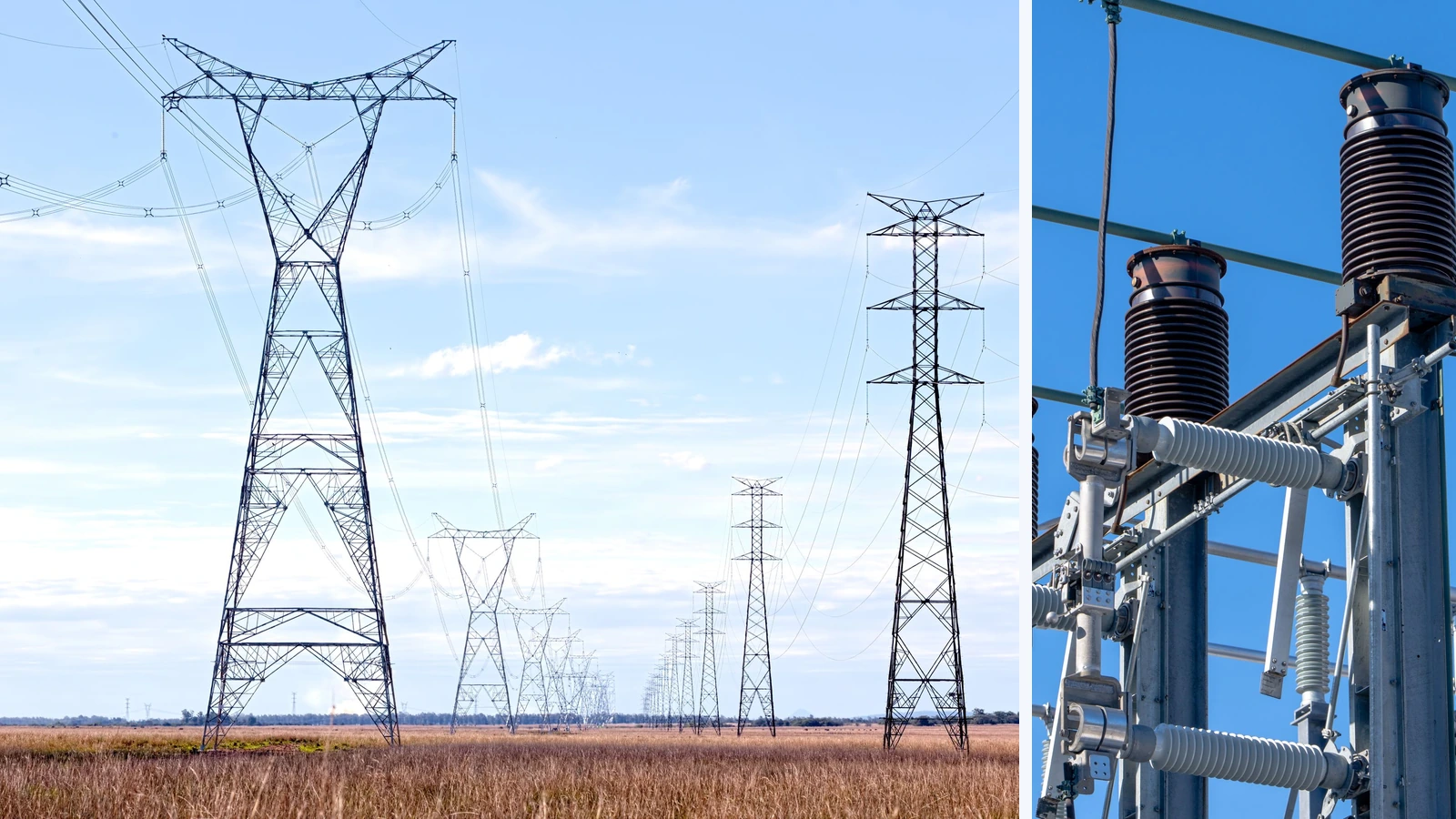
It is easy to be seduced by the sticker price of a switchgear lineup, but doing so can prove costly in the long term. The selected lineup may require additional real estate, civil/building modifications, and ongoing maintenance beyond what is available at the facility.
In selecting between gas-insulated and air-insulated, key considerations to weigh up include the available space, environmental conditions, and required maintenance regime during the anticipated operating life of the equipment.
Either type can be used to isolate, sectionalise, and switch an electrical network, albeit in different manners as described below.
What you will find in this article
- Operating Principles
- Space Available and Environmental Conditions
- Installation, Maintenance, Ownership
- SF6
- Considerations for Selection
- Summary
Operating Principles
- Air-insulated (AIS): Air forms the primary means of dielectric separation between live parts and earth, e.g. the enclosure, for MV switchgear, housed within a protective, insulated, compartmentalised cubicle.
- Gas-insulated (GIS): Live components, primarily busbars, are encased in a gas-filled, hermetically-sealed enclosure, allowing a reduced physical size to deliver equivalent electrical performance, i.e. shorter line-up.
It should be noted that the above applies to insulation, rather than arc quenching, which is performed by the relevant switching device, such as a circuit breaker or load-break switch. As such, it is possible to have GIS that utilises vacuum breaking, and/or gas-filled breakers in an AIS lineup. Therefore, a lineup is not necessarily all gas-filled, and it is worth querying with manufacturers to confirm both insulation and interruption media.
Space Available and Environmental Conditions
This is probably the primary differentiator between the two types.
- An AIS lineup will require greater distances between components, allowing access, cabling, etc., and so will generally be longer. If there is ample space, be it outdoors, indoors, or otherwise, then this may not be an issue.
- By contrast, GIS will offer a more condensed layout, which could prove advantageous if the existing facility is tight, being extended, or to facilitate installation in close proximity, e.g. behind IT suites in data centres, etc.
The gas-insulated switchgear in an outdoor-rated configuration with sealed gas-filled primary compartments may therefore be beneficial where providing an additional electrical substation/building may be impractical, although appropriate ingress protection, clearances, and layout would need to be assessed.
Depending on the ambient conditions, AIS may suffer from an increased build-up of dirt, condensation, saline, or other particulates, which will require more frequent cleaning/maintenance. With the live components of GIS enclosed, they are protected from this to some extent, though suitable IP, ventilation, etc., must be considered for any AIS lineup installed in harsh environments.
The above should therefore be considered in addition to the line-up size, including any ancillaries, e.g. working space, plinth, cable entry, building, etc., to assess the overall space occupied by each solution.
Installation, Maintenance, Ownership
Once again, cost of supply of the lineup may favour AIS, and allow simpler, lower-cost maintenance, rectification, and adaptation by the customer, particularly if additions/changes to the line-up are expected, given its open nature. Conversely, while GIS may have a higher acquisition cost, could drive down associated capital costs, e.g. by requiring less space, thereby limiting the extent of civil, building, and/or mechanical works, depending on the facility, potentially exceeding the savings offered by an AIS alternative.
While GIS, due to its encapsulation, may not require as much preventative cleaning, it does necessitate consideration of the gaseous medium, including whether gas monitoring, top-up, or recovery is needed for the specific design, as well as special tools, etc., if intervention is required. For this reason, remedial works could result in extended outage periods, although AIS has no sealed insulating-gas system in its primary air-insulated sections (apart from any gas-filled circuit breakers).
However, as noted, dust, condensation, dirt, wear, and tear will all require ongoing inspection, maintenance, and servicing of an AIS lineup, and hence it is not wholly clear-cut which type is more advantageous in terms of ownership costs, and it is recommended that the total cost of ownership is estimated, including any expected downtime, for both alternatives, prior to selection. Additionally, access to maintenance services and response times should be confirmed, particularly if availability is of importance to the installation.
SF6
SF6, while highly effective, has a significant global warming potential, and emissions from leaking, maintenance, and/or decommissioning, must be managed accordingly, adding further considerations to the overall scheme, as outlined above.
As mentioned, there are other gases, and even air, that can be employed as the insulating medium, dependent on voltage, design, etc. So it is important to review the details of the specific GIS product proposed. Furthermore, as per a recent survey of ENTSO-E TSOs, it is estimated that 4,238 SF6-free GIS bays, are expected to be installed by 2035, reflecting replacement, renewal, and growth across Europe, but these are solely transmission assets, and cannot be extrapolated to the wider, e.g. MV, market.
There are, or will be, a number of regulations, e.g. EU, California, restricting, phasing out, or banning, the installation, or continued use, of certain gas-filled switchgear, including, as of 1st January 2026, placing in service of fluorinated-gas MV, primary and secondary, substation equipment, ≤ 24kV, with certain exemptions, in the EU under Regulation (EU) 2024/573, and hence these factors should be incorporated into the above assessment, and may influence, or limit, the final decision, along with end-of-life decommissioning considerations, etc.
Importantly, although AIS uses air as its primary insulation, it should be noted that the circuit breakers, and therefore line-ups, may contain SF6, so this should be carefully considered, in particular in light of the regulations, as well as any gas management requirements, outlined above, even if selecting AIS.
Considerations for Selection
Once the above has been established and the requirement for the switchgear, in terms of kV, A, kA, protection, etc. defined, and a compliant line-up selected, the following should be evaluated, and if applicable, revisited, throughout the design, procurement, and construction process:
- Space – as above, considering any additions, e.g. for cabling.
- Ambient/environment, including ingress, condensation, temperature, pollution, etc.
- Ongoing maintenance, access, and service, including consumables, tools, parts, personnel, downtime, etc.
- Future expansion, restrictions, repairs, decommissioning, cost, etc.
- Availability, lead times, testing, certification, etc., of the selected configuration, to ensure timely delivery and completion, if necessary.
For essential circuits, it would be prudent to also consider the line-up arrangement, to minimise impact to other, healthy, circuits, when isolating, maintaining, and/or testing, individual sections, e.g. number/location of breakers and busbar arrangements.
Summary
As such, it is reasonable to select AIS where sufficient space, environment, and maintenance access/means are available, and/or it may offer benefits, e.g. lower cost, ease of intervention, etc.
Conversely, GIS, due to its reduced size, can offer an attractive, sealed, and low-maintenance solution, however, careful consideration of the gas, maintenance, regulation, and other points above, should be undertaken, before it can be definitively determined to be the preferred selection.
Ultimately, whichever solution is selected, should ensure the switchgear fulfils the required function, and can be practically, safely, and cost-effectively accommodated, operated, and maintained, by the client, throughout its life, and beyond, as applicable.
