
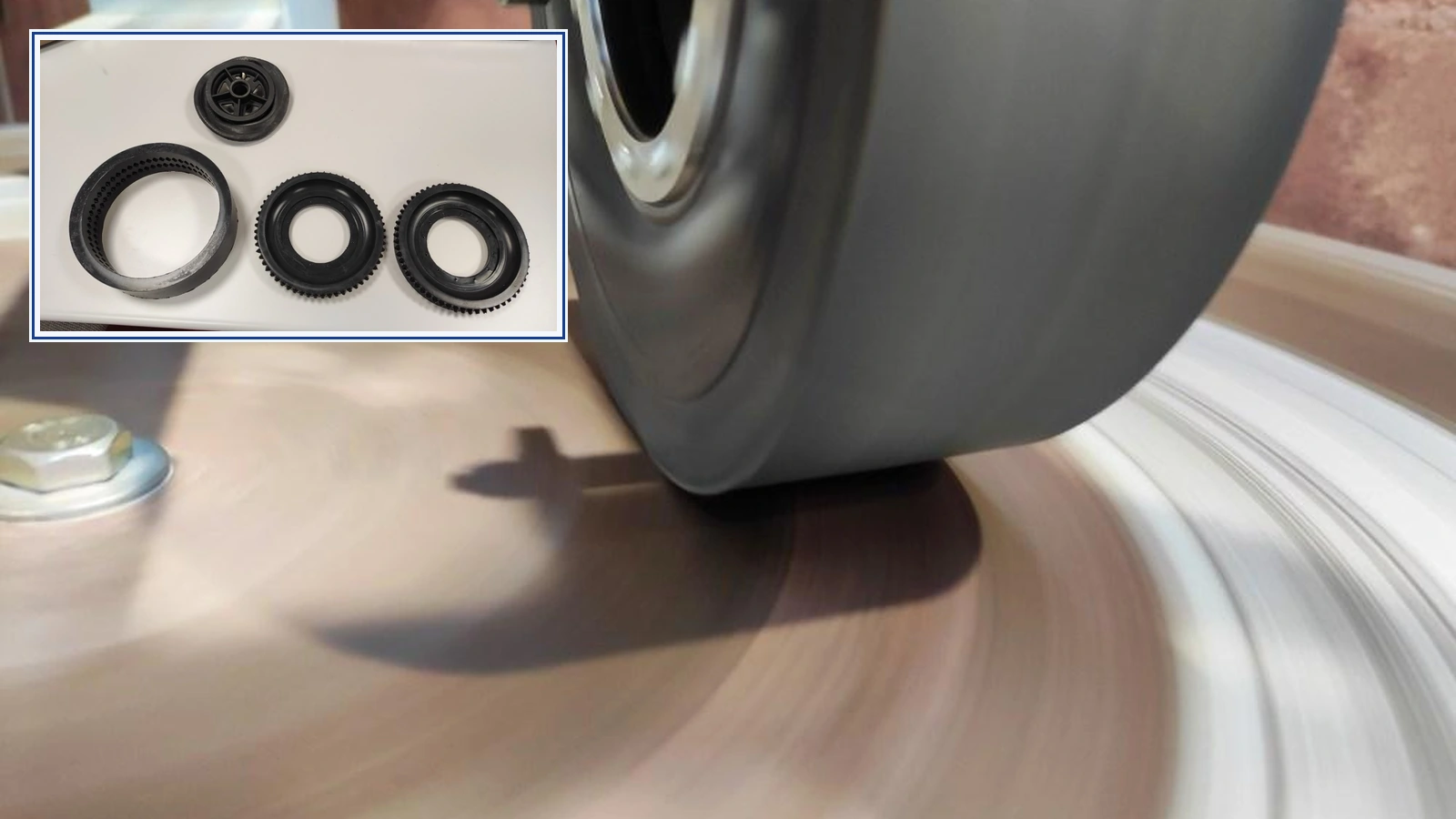
Researchers at Universidad Carlos III de Madrid (UC3M) have tested a tire prototype whose tread can be removed while its casing is retained. The tread stayed attached throughout laboratory trials at its intended inflation pressure, although lower pressure allowed parts of the connection to separate.
The Spanish university described the ECOTIRE project in an October 6 announcement. Its proposed design would allow the worn tread, the outer surface that contacts the road, to be replaced without discarding the main tire structure.
According to UC3M, the removable tread represents less than 20% of the tire’s total weight. Keeping a sound casing in service could reduce the material needed for replacements.
The prototype remains experimental. The rolling study used a model at one-third scale, and its results concern the connection between tread and casing, not the performance of a finished passenger-car tire.
A removable connection instead of a bonded tread
ECOTIRE uses interlocking shapes to hold the tread against the casing. The parts fit together mechanically, allowing them to be separated for replacement.
Reusing a casing is already established in commercial tire retreading. Operators inspect a used tire, remove worn tread and attach a replacement. Continental’s description of its retreading processes explains how replacement tread is bonded to a prepared casing through curing.
ECOTIRE uses a detachable joint that avoids bonding the replacement tread to the casing. For a manufacturer or service business, that could change the replacement process, provided the connection remains secure and the casing is suitable for continued use.
That requirement makes the joint a central engineering problem: it must withstand deformation during rolling while still allowing deliberate disassembly.
What is tire slip?
Tire slip describes differences between a tire’s motion and ideal rolling contact with the road. During acceleration or braking, the travel speed implied by wheel rotation can differ from the vehicle’s forward speed.
During cornering, slip angle is the angle between the direction a wheel points and the direction it actually travels. Small slip angles are part of normal cornering and help tires develop the sideways forces needed to turn.
For ECOTIRE, the researchers wanted to establish whether rolling with slip would make the removable tread shift or pull away from its casing.
Inflation pressure determined stability
In the study published in Measurement, Daniel García-Pozuelo and colleagues tested the prototype on a rotating disc. They varied load, position on the disc and slip conditions at inflation pressures of 1 bar and 0.5 bar.
At 1 bar, the prototype’s nominal operating pressure, the joint stayed engaged in every tested combination. At 0.5 bar, localized, reversible separation occurred when demanding conditions coincided. These pressures apply to the experimental prototype, not to inflation recommendations for ordinary car tires.
Extended rolling covered approximately 12,000 revolutions, equivalent to about 7 kilometers. Inspection found no visible external damage, and the measured tread mass changed by less than 0.1 grams.
The authors caution that particles could remain inside the assembly, making mass measurements insufficient to establish wear resistance. The distance was a preliminary integrity check, not a service-life test.
Material choices and commercial questions
The prototype used silicone rubber. A separate Applied Sciences study compared silicone with a natural and synthetic rubber blend in laboratory wear and friction tests. Silicone lost substantially less material under the tested abrasive conditions.
Those results concern specific material samples. A tire compound must also provide adequate grip, tolerate changing temperatures and withstand prolonged loading. The rolling-study authors describe silicone as an experimental material, not their final commercial choice.
UC3M also envisages sensors that could measure contact forces, pressure and available friction for vehicle-control systems. Detecting hazards such as ice or aquaplaning is part of the project’s proposed direction; the rolling experiment assessed mechanical attachment.
The commercial case would depend on more than replacing a smaller quantity of material. Manufacturers would need to assess casing life, replacement and inspection costs, production requirements and whether the complete system delivers environmental savings over repeated use.
UC3M’s announcement gives no product price or launch date. Full-scale testing, driving and braking torque, temperature effects, uneven surfaces and long-term fatigue remain among the work needed to assess the design for road use.
