

UK

UK July industrial output up

Published: 12:03, September 9, 2014

UK July industrial output increased by 0.5% after rising by 0.3% in June, driven mainly by a 3.6% jump in gas and electricity output, according to figures published by the Office for National Statistics. Most economists had expected a 0.2% increase for July.

However, the country’s trade deficit also grew.

Year-on-year, industrial output was up by 1.7% in July, which reflected a 2.2% increase in manufacturing and a 3.4% rise in air conditioning, steam, gas and electricity output.

Manufacturing in July grew by 0.3%, which was about the same as forecasts.

Over a three-month period ending in July, however, industrial production declined by 0.1% compared to the same period a year earlier – the first fall in one-and-a-half years.

In the quarter ending in July 2014, production and manufacturing were 11.3% and 7.6% respectively below the first quarter of 2008, a peak reached just before the global crisis hit.

Manufacturing is losing some of its steam as the Ukraine crisis kills off demand in the Eurozone, the country’s largest trading partner. GDP growth in the European currency bloc flatlined in the second quarter.
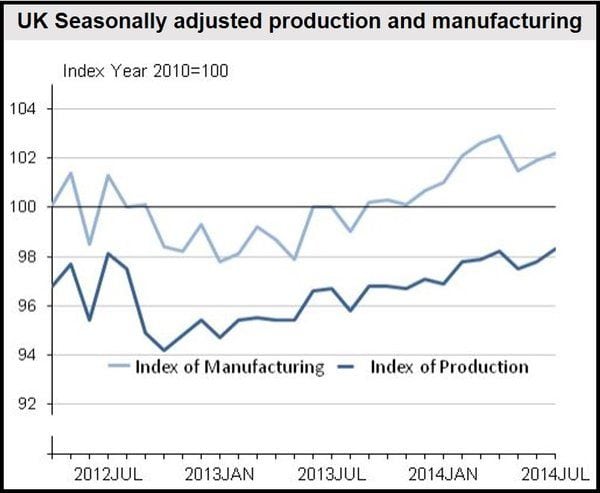
UK July Industrial Production

(Source: ONS)

Trade deficit up

According to the Office for National Statistics, UK’s trade deficit in goods jumped to ₤10.186 billion, compared to forecasts of about ₤9.1 billion. July’s deficit was the highest in 2.5 years.

The deficit was driven by a steep increase of aircraft imports.

From June 2014 to July 2014, exports rose by ₤0.5 billion to ₤24 billion, while imports increased ₤1.3 billion to ₤34 billion.

Trade with non-EU nations accounted for the bulk of the increase in imports and exports in July.

Germany posted record exports as well as a record trade surplus in July.

Christian Nordqvist Avatar

Other News

Worker interviews uncover job tasks missing from standard occupation lists

Nov 24, 2026

Startup training was followed by more closures and stronger funding results in a US experiment

Nov 24, 2026

Information about local rivals changed firms’ AI investment plans in a European study

Nov 24, 2026

Online job ads can understate small employers’ share of hiring opportunities

Nov 24, 2026

How IBM expanded marketing experiments by changing who could run them

Nov 24, 2026

Grocery discounts do not lift every brand’s sales equally, study finds

Nov 24, 2026

A low upfront price can obscure the cost of refills, study finds

Nov 24, 2026

How medical device startups describe their products may affect clearance times

Nov 23, 2026

Why cheaper grocery products can face faster inflation when costs rise

Nov 23, 2026

One office day a month was followed by more calls handled in a remote-work experiment

Nov 23, 2026

An AI shopping assistant increased sales in a livestream experiment

Nov 23, 2026

Starting an idea without AI changed employees’ sense of ownership in an H&M test

Nov 23, 2026

Showing the extra cost of a larger pack changed buying choices in an online test

Nov 23, 2026

Looking at products together can help identify competitors, camera study finds

Nov 23, 2026

Removing unauthorized book copies produced an uncertain sales result in a field experiment

Nov 23, 2026

Warnings did not consistently undo the influence of product lineups

Nov 23, 2026

Demographic ad targeting can change how fairly consumers view a brand

Nov 22, 2026

Matching online and store prices had mixed effects at one electronics retailer

Nov 22, 2026

Meal-kit displays showed no clear sales lift for plant-based products in Belgian stores

Nov 22, 2026

High switching costs weakened price competition in a laboratory market

Nov 22, 2026