
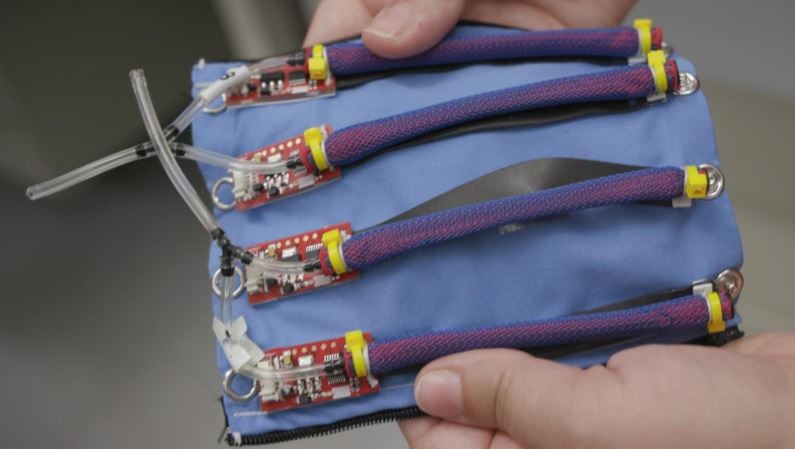
Robotic skins can turn everyday objects into robots. When most people think of robots, they imagine a rigid, heavy device that an engineer created for a specific purpose.
With new Robotic Skins technology, however, scientists at Yale University and Purdue University have turned that notion on its head.
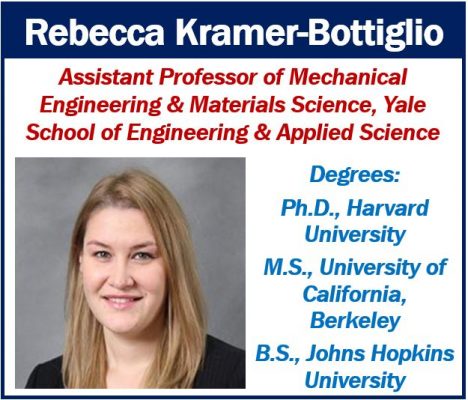
Rebecca Kramer-Bottiglio and colleagues developed the robotic skins in her lab. Kramer-Bottiglio is an Assistant Professor of Mechanical Engineering and Materials Science at Yale’s School of Engineering & Applied Science.
Prof. Kramer-Bottiglio and colleagues wrote about their work in the journal Science Robotics (citation below).
Even though they designed the robotic skins with no specific task in mind, they have many possible applications. They could be used, for example, as search-and-rescue robots. Prof. Kramer-Bottiglio said we could also use them for wearable technologies.
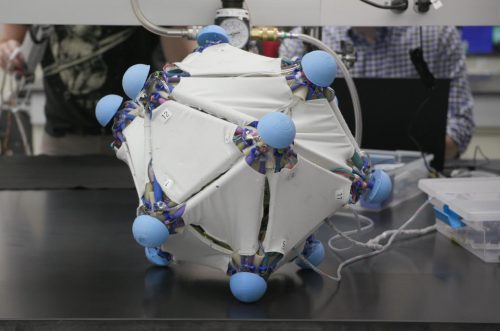
Robotic skins animate objects
The researchers made the skins from elastic sheets, which they embedded with sensors and actuators. They developed the sensors and actuators in Kramer-Bottiglio’s lab.
If you place the skins on the surface of a deformable ‘inanimate’ object, it becomes ‘animated.’ In other words, the robotic skins can make things move. You can make a stuffed animal or foam tube, for example, move after placing the robotic skins on them.
Many different tasks
These makeshift robots can perform a variety of tasks. What they can do depends on how the researchers apply the skin and also on the soft objects’ properties.
Regarding the different tasks the makeshift robots can perform, Prof. Kramer-Bottiglio said:
“We can take the skins and wrap them around one object to perform a task — locomotion, for example — and then take them off and put them on a different object to perform a different task, such as grasping and moving an object.”
“We can then take those same skins off that object and put them on a shirt to make an active wearable device.”
When we create a robot, we usually have a single purpose in mind. Perhaps we make them to help in the production of vehicles or to disarm a bomb.
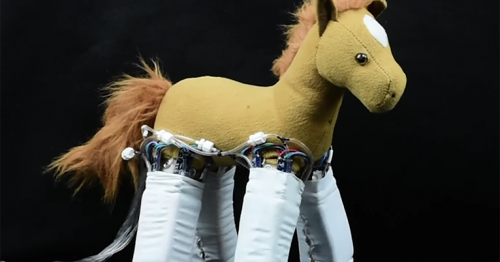
Multi-functional robots
The robotic skins, on the other hand, allow us to create multi-functional robots as we go along. This means that we can use them in settings that we had never considered when we designed them, said Prof. Kramer-Bottiglio.
Additionally, if we use more than one skin simultaneously, the makeshift robot can perform complex movements.
You can layer the skins, for example, to get different types of motion. “Now we can get combined modes of actuation – for example, simultaneous compression and bending,” Prof. Kramer-Bottiglio explained.
Robotic skins in action
The scientists created a handful of prototypes to demonstrate the robotic skins in action.
They applied the skins to foam cylinders, which then started to move like an inchworm. There was a search-like wearable device that could help correct poor posture. There was also a device with a gripper that could grasp and move things.
Partnership with NASA
A few years ago, NASA put out a call for soft robotic systems. That was when Prof. Kramer-Bottiglio came up with the idea of robotic skins.
In fact, the Yale and Purdue engineers designed the technology in partnership with NASA. The authors say that its reusable and multi-functional features will allow astronauts to carry out a range of tasks with the same material. All they have to do is reconfigure it.
For example, with the robotic skins, engineers can make a robotic arm out of a piece of foam. They can then remove it and apply it to create a soft Mars rover that can roll over the Red Planet’s rough terrain.
If you have robotic skins on board, you can potentially turn virtually anything into a robot with a purpose, the authors explained. Anything from balls of crumpled paper to balloons.
Prof. Kramer-Bottiglio said:
“One of the main things I considered was the importance of multifunctionality, especially for deep space exploration where the environment is unpredictable. The question is: How do you prepare for the unknown unknowns?”
Prof. Kramer-Bottiglio recently received a $2 million grant from the National Science Foundation for the same line of research. It forms part of the Emerging Frontiers in Research and Innovation program.
Citation
“OmniSkins: Robotic skins that turn inanimate objects into multifunctional robots,” Joran W. Booth, Dylan Shah, Jennifer C. Case, Edward L. White, Michelle C. Yuen, Olivier Cyr-Choiniere, and Rebecca Kramer-Bottiglio. Science Robotics, 19 Sep 2018: Vol. 3, Issue 22, eaat1853. DOI: 10.1126/scirobotics.aat1853.
